

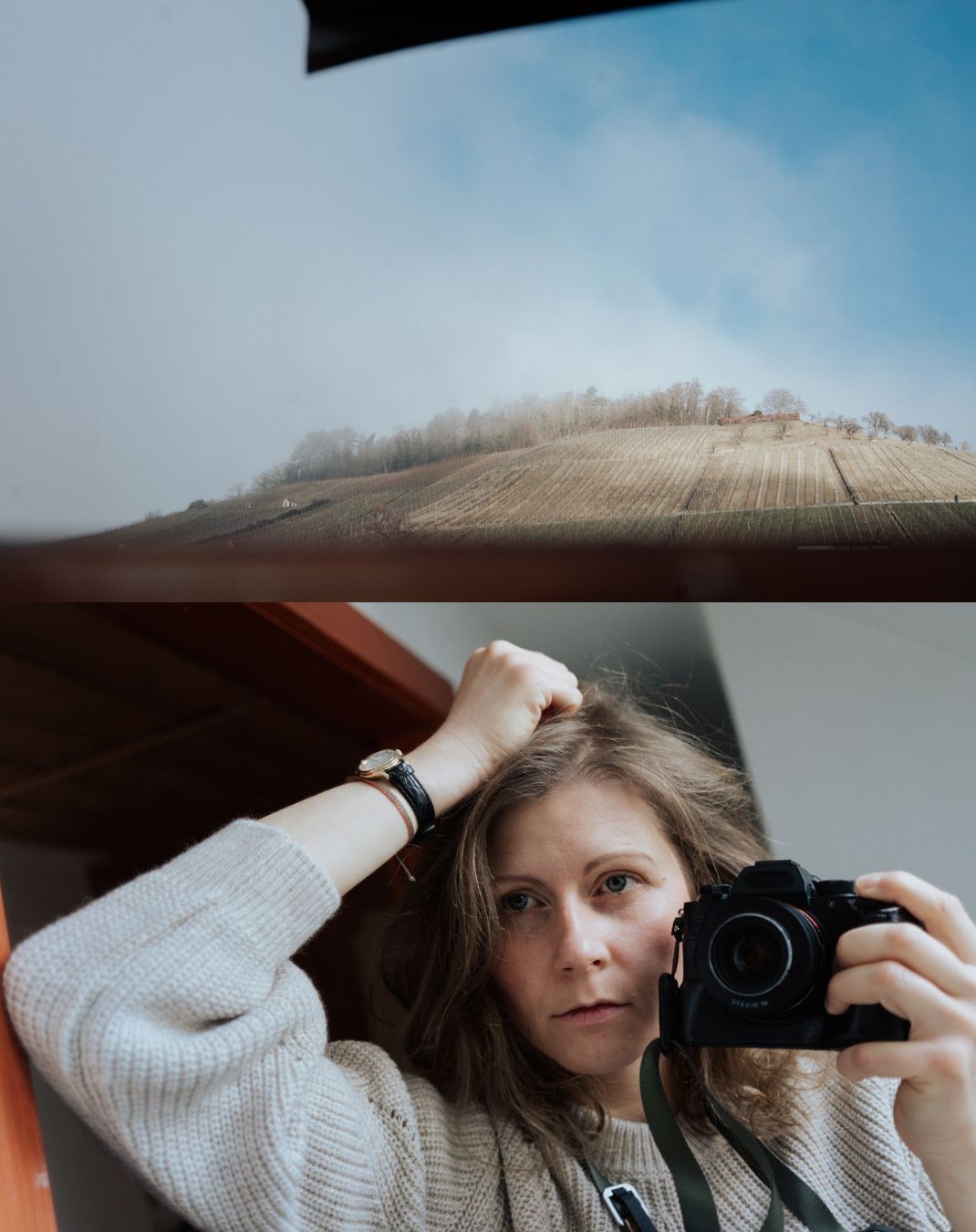
Text und Fotografie: Nadine Wilmanns
Ich im Spiegel
“’I know that mirrors give us a false sense of confidence.’ I continued. ‘The reflection that we see everyday has nothing to do with how others see us. The glass lies.'”
(from the short story collection Human Detritus by Rasmenia Massoud)
Why do we look so different in photos than the picture of us that we see in the mirror? Apart from the fact that we automatically adjust our facial expressions in front of the mirror so that we like how our face looks, it’s mostly because our face is being mirrored.
Let me explain: I, for example, have a very asymmetrical face. Even my nose points to one side, so it only looks pretty to me if I photograph it from a very particular angle. For me, it’s always striking how much “better” I look when I look at myself in the mirror. But in reality, I don’t look any better; I just look more familiar.
There’s a funny phenomenon called the mere-exposure effect. It suggests that we prefer things simply because we are used to them.
Our brain thinks: “familiar” – and automatically connects it with “good.”
We have been looking at ourselves mirrored all our lives and have never seen ourselves “right” — except when looking at photos of ourselves. Our mirrored face is the one we’ve grown used to.
So we usually don’t look worse in pictures, just unfamiliar.
People often tell me that they don’t like having their photo taken. I always say that I like it, and I truly mean it. First, it’s a nice thing that someone cares enough to make the effort to take a photo of you. Second, I always find it interesting to see how I look in real life — not as a controlled, mirrored me, but as the person that other people see.
And of course, the more photos of myself I see, the more familiar this view becomes. When my brain recognizes a photo of me, it’s more likely to genuinely think: good.
Im Spiegel anders
“‘Ich weiß, dass Spiegel uns ein falsches Gefühl von Selbstvertrauen geben’, fuhr ich fort. ‘Das Spiegelbild, das wir jeden Tag sehen, hat nichts damit zu tun, wie andere uns sehen. Das Glas lügt.’“
(aus der Kurzgeschichten-Sammlung Human Detritus von Rasmenia Massoud)
Warum sehen wir auf Fotos so anders aus als auf dem Bild, das wir im Spiegel sehen? Abgesehen davon, dass wir unsere Mimik vor dem Spiegel automatisch so anpassen, dass uns unser Gesicht gefällt, liegt das vor allem daran, dass unser Gesicht gespiegelt wird.
Lasse mich das erklären: Ich habe zum Beispiel ein sehr asymmetrisches Gesicht. Sogar meine Nase ist zu einer Seite geneigt, sodass ich sie nur dann dann schön finde, wenn ich sie aus einem ganz bestimmten Winkel fotografiere. Für mich ist es immer wieder auffällig, wie viel „besser“ ich aussehe, wenn ich mich im Spiegel betrachte. Aber in Wirklichkeit sehe ich nicht besser aus, ich bin mir nur vertrauter.
Es gibt ein lustiges Phänomen, den Mere-Exposure-Effekt. Er besagt, dass wir Dinge einfach deshalb bevorzugen, weil wir an sie gewöhnt sind. Unser Gehirn denkt: „vertraut“ – und verbindet dies automatisch mit „gut“.
Wir haben uns unser ganzes Leben lang im Spiegel betrachtet und uns nie „richtig“ gesehen – außer auf Fotos von uns selbst. An diese Spiegelbildversion haben wir uns also gewöhnt.
Deshalb sehen wir auf Fotos normalerweise nicht schlechter aus – nur ungewohnt.
Leute erklären mir oft, dass sie nicht gerne fotografiert werden. Ich sage immer, dass ich es mag, und das meine ich auch so. Erstens ist es schön, dass du jemandem wichtig genug bis, dass er sich die Mühe macht, ein Foto von dir zu machen. Zweitens finde ich es interessant zu sehen, wie ich im wirklichen Leben aussehe – nicht als mein kontrolliertes Spiegelbild, sondern als die Person, die die anderen sehen.
Und natürlich wird mir dieser Blick auf mich selbst umso vertrauter, je mehr Fotos ich von mir selbst sehe. Wenn mein Gehirn ein Foto von mir erkennt, denkt es dann viel eher: “gut”.